

-196℃+3D printing, new technology makes biological tissue storage more convenient
Release time:
2022-03-04
According to a recent paper in the journal "Materials", researchers from Brigham and Women's Hospital and Harvard Medical School combined 3D bioprinting with cryopreservation technology to create tissue that can be stored in a freezer at minus 196°C. , and can be defrosted in minutes for immediate use.
A major obstacle to widespread research and clinical application of 3D printed biological tissues is their short shelf life, which can range from hours to days. Like an organ transplant, biological tissue must be transported quickly to where it is needed or it will not survive.
The use of 3D bioprinting technology to create artificial human tissues first appeared 20 years ago. Unlike traditional 3D printing, in bioprinting, the ink usually consists of a gelatin-like scaffold embedded with living cells. Cryobioprinting works on the same principle, except that printing is performed directly on a cold plate with temperatures as low as minus 20°C. After the tissues are printed, they are immediately moved to cryogenic conditions for long-term storage.
Low-temperature printing has the added advantage that it can create more complex shapes than traditional bioprinting methods. "The bioink filaments freeze within milliseconds of reaching the cold plate and do not deform," said lead author Y. Shrek Zhang, a biomedical engineer at Brigham and Women's Hospital. "Then we can create layer by layer A self-contained 3D structure.”
The use of low temperatures also removes restrictions on the types of printing inks that can be used. In traditional bioprinting methods, the ink must be viscous to maintain its shape, but most liquids naturally become more viscous at lower temperatures.
Cryopreservatives are essential for cells to survive at low temperatures, preventing osmotic shock and limiting the formation of ice crystals that can damage cell membranes. The researchers this time focused more on finding cryopreservatives that can maintain cell viability to the greatest extent.
They demonstrated that biological tissue could be preserved for at least three months before it came back to life again. "Resurrecting biological tissue is like reviving any type of cryogenically stored cells, by putting them back into a warm medium and thawing them quickly," Zhang said.
To prove that these tissues could retain their original functions, the researchers conducted a series of cell viability assays to demonstrate that the cells could undergo the differentiation process as before.
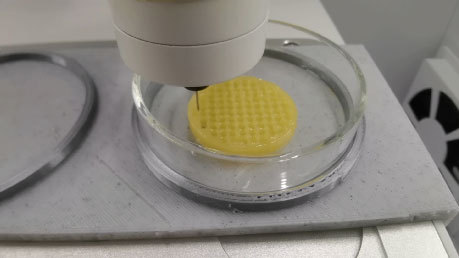
In the future, 3D biological tissue printing may become a realistic model for testing new drugs or helping patients who need tissue replacement after disease or injury. The ability to freeze bioprinted tissues for long periods of time will allow researchers to further collaborate on developing these applications, with the opportunity to extend their storage for use in preclinical and clinical settings.
At present, Shandong Yinfeng Life Sciences Research Institute has formulated a 3D bioprinting roadmap based on the previously developed allogeneic tissue engineering repair materials with good biocompatibility, and is committed to new bioprinting "inks" using 3D biological Printing technology enables rapid, refined and customized molding of biological scaffolds, providing more accurate personalized repair materials for tissue loss and damage caused by surgery, various diseases and accidents. It has good application prospects as a biological scaffold in the filling and regeneration repair of diabetic foot and various soft tissues.
Latest developments

The debut and discourse of the YinFeng Life Continuation Project not only served as an authoritative demonstration of its own ethical governance framework but also contributed practical wisdom toward establishing industry norms.

Yinfeng Foundation Honored as "2025 Public Welfare Donor" by Jinan Red Cross
Looking ahead, Yinfeng Foundation will use this recognition as an opportunity to further deepen its strategic collaboration with the Jinan Red Cross, expand cooperation in areas such as life health and emergency response, and continue to empower efforts to accelerate the construction of a "new, strong, excellent, rich, beautiful, and high-quality" modern socialist strong capital city, contributing even more Yinfeng strength to this endeavor.

The team successfully developed the CryoSIM platform, an intelligent microfluidics and deep learning-integrated system. This platform deeply integrates core technologies of deep learning and microfluidics to enable high-throughput, high-precision automated analysis of oocyte membrane permeability. It provides a novel technological tool for optimizing and advancing the clinical translation of oocyte cryopreservation techniques. Additionally, it offers an innovative practical paradigm for the application of artificial intelligence in low-temperature biomedicine and reproductive medicine.

Public Welfare Partnership: A Special Letter from the Jinan Red Cross
On the afternoon of January 30, 2026, the Jinan Red Cross presented a letter of special significance to the Shandong Yinfeng Life Science Public Welfare Foundation (hereinafter referred to as the Yinfeng Foundation).

World’s First Achievement Highlights Brand Leadership
In the future, Yinfeng Life Science Research Institute will continue to uphold its mission of "Dedicated to Medical Technology, Safeguarding Human Health." It will empower brand building with more original and pioneering scientific and technological achievements, contributing wisdom and strength to Shandong's goal of building a national regional innovation hub and promoting Chinese brands on the global stage.

Global First Ovarian Tissue Dual Activation Technology Debuts at 2025 Jinan Achievements Conference
Currently, the ovarian tissue dual activation technology has been successfully applied in clinical practice at Beijing University of Chinese Medicine Shenzhen (Longgang) Hospital, having treated over 400 patients with a treatment success rate of 70%. Over the next three years, Shandong Yinfeng Life Science Research Institute plans to use Jinan as a center to gradually expand the transformation and application of this technological achievement nationwide.
Yinfeng Life Continuation Plan
Address: Yinfeng Biotechnology Park, 1758 Gangyuan 6th Road, High-tech Zone, Jinan City, Shandong Province
Zip Code: 250102
Telephone: 0086-0531-88897351
Mobile: 0086-19953155515

Mobile website

Official WeChat Public Number
Links:Red Cross Society of China丨Shandong Red Cross Society丨Shandong Provincial Health Commission | Yinfeng Group| Yinfeng Biological Group
All rights reserved©Yinfeng Life Continuation Powered by www.300.cn SEO