

Yinfeng Institute of Biological Sciences’ research results on “Stem Cells Promote New Bone Growth” were published in foreign journals
Release time:
2021-02-25
Large-segment bone defects are common clinical diseases, and stem cells and bone tissue engineering are considered to be a promising method for bone regeneration. Recently, a team from Shandong Yinfeng Life Sciences Research Institute and Shandong University collaborated to study a nanocellulose membrane platform for multi-lineage differentiation of stem cells to biomimetically construct bioactive three-dimensional bone-like tissue, which can significantly promote the rapid growth of new bone and capillary growth. Rapid formation of blood vessels and nerve fibers.
The relevant results were published in "Advanced Healthcare Materials" (IF=7.367, JCR Area I) under the title "Nanocellulose-ReinforcedHydroxyapatite Nanobelt Membrane as a Stem Cell Multi-Lineage DifferentiationPlatform for Biomimetic Construction of Bioactive 3D Osteoid Tissue In Vitro".
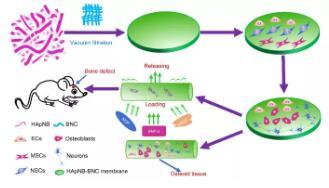
Schematic diagram of multi-differentiation platform for bone regeneration
Large-segment bone defects are common clinical diseases, especially the treatment of severe bone defects accompanied by multi-tissue damage (tissue damage of blood vessels and peripheral nerves) remains a huge challenge, often leading to bone nonunion and other Sequelae may even lead to lifelong disability. Stem cells and bone tissue engineering, as one of the most promising bone regeneration methods, have attracted widespread attention.
"Most previous research related to bone tissue engineering scaffolds focused on the differentiation of osteoblasts, and great progress has been made," said Wei Benjie, the team leader of the project. In fact, bone regeneration involves not only bone formation; Other parts such as blood vessels and nerves are involved to ensure the function of the bone.
During the bone repair process, if there is no new blood and nerve formation in the new bone, the regeneration of the bone defect will fail, resulting in a poor prognosis. Therefore, bone tissue engineering for clinical treatment of bone defects should consider the formation of all important parts of bone, among which bone, blood vessels, and nerves are particularly important. Since it is difficult to achieve co-culture or multi-lineage differentiation of different cells in the same scaffold or system, there are few relevant studies to achieve coordinated regeneration of osteoblasts, vascular cells and neuronal cells. Therefore, developing a stem cell multi-lineage differentiation platform to biomimetically construct bioactive three-dimensional bone-like tissue for bone regeneration remains an urgent problem to be solved.
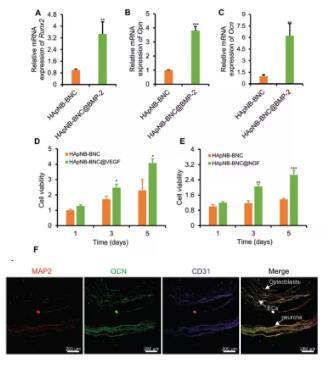
In vitro reconstruction of bone-like tissue
It is reported that this article synthesizes a nanocellulose-reinforced hybrid membrane with high mechanical properties and biodegradable properties by assembling ultra-long hydroxyapatite nanoribbons in nanocellulose hydrogel, realizing the application of stem cells in osteoblasts, Nerve cells and vascular endothelial cells coordinate differentiation and regeneration. Utilizing the multi-directional differentiation characteristics of the biomimetic hybrid membrane, bioactive 3D bone-like tissue can be simulated and constructed in vitro through layer-by-layer superposition, culture and integration methods.
The results of the 8-week ectopic and in situ osteogenesis experiments showed that the bone-like tissue constructed in vitro significantly promoted the rapid growth of new bone and the rapid formation of capillaries and nerve fibers, proving its strong bone regeneration ability. This study demonstrates the wide application of hybrid membranes as a multi-lineage differentiation platform for stem cells and has broad application prospects in bone tissue engineering.
Latest developments

The debut and discourse of the YinFeng Life Continuation Project not only served as an authoritative demonstration of its own ethical governance framework but also contributed practical wisdom toward establishing industry norms.

Yinfeng Foundation Honored as "2025 Public Welfare Donor" by Jinan Red Cross
Looking ahead, Yinfeng Foundation will use this recognition as an opportunity to further deepen its strategic collaboration with the Jinan Red Cross, expand cooperation in areas such as life health and emergency response, and continue to empower efforts to accelerate the construction of a "new, strong, excellent, rich, beautiful, and high-quality" modern socialist strong capital city, contributing even more Yinfeng strength to this endeavor.

The team successfully developed the CryoSIM platform, an intelligent microfluidics and deep learning-integrated system. This platform deeply integrates core technologies of deep learning and microfluidics to enable high-throughput, high-precision automated analysis of oocyte membrane permeability. It provides a novel technological tool for optimizing and advancing the clinical translation of oocyte cryopreservation techniques. Additionally, it offers an innovative practical paradigm for the application of artificial intelligence in low-temperature biomedicine and reproductive medicine.

Public Welfare Partnership: A Special Letter from the Jinan Red Cross
On the afternoon of January 30, 2026, the Jinan Red Cross presented a letter of special significance to the Shandong Yinfeng Life Science Public Welfare Foundation (hereinafter referred to as the Yinfeng Foundation).

World’s First Achievement Highlights Brand Leadership
In the future, Yinfeng Life Science Research Institute will continue to uphold its mission of "Dedicated to Medical Technology, Safeguarding Human Health." It will empower brand building with more original and pioneering scientific and technological achievements, contributing wisdom and strength to Shandong's goal of building a national regional innovation hub and promoting Chinese brands on the global stage.

Global First Ovarian Tissue Dual Activation Technology Debuts at 2025 Jinan Achievements Conference
Currently, the ovarian tissue dual activation technology has been successfully applied in clinical practice at Beijing University of Chinese Medicine Shenzhen (Longgang) Hospital, having treated over 400 patients with a treatment success rate of 70%. Over the next three years, Shandong Yinfeng Life Science Research Institute plans to use Jinan as a center to gradually expand the transformation and application of this technological achievement nationwide.
Yinfeng Life Continuation Plan
Address: Yinfeng Biotechnology Park, 1758 Gangyuan 6th Road, High-tech Zone, Jinan City, Shandong Province
Zip Code: 250102
Telephone: 0086-0531-88897351
Mobile: 0086-19953155515

Mobile website

Official WeChat Public Number
Links:Red Cross Society of China丨Shandong Red Cross Society丨Shandong Provincial Health Commission | Yinfeng Group| Yinfeng Biological Group
All rights reserved©Yinfeng Life Continuation Powered by www.300.cn SEO