

A Blockbuster in Science! U.S. Discovers a Switch to Reverse Diabetes, Offering Hope for Treatment
Release time:
2025-06-13
A groundbreaking study published in the international top - tier journal Science in February this year may bring revolutionary hope to hundreds of millions of type 2 diabetes patients worldwide. The team of scientists from the University of Michigan in the United States not only uncovered a core secret of diabetes onset but, even more excitingly, they successfully reversed the damage, which may completely transform the diabetes treatment model.
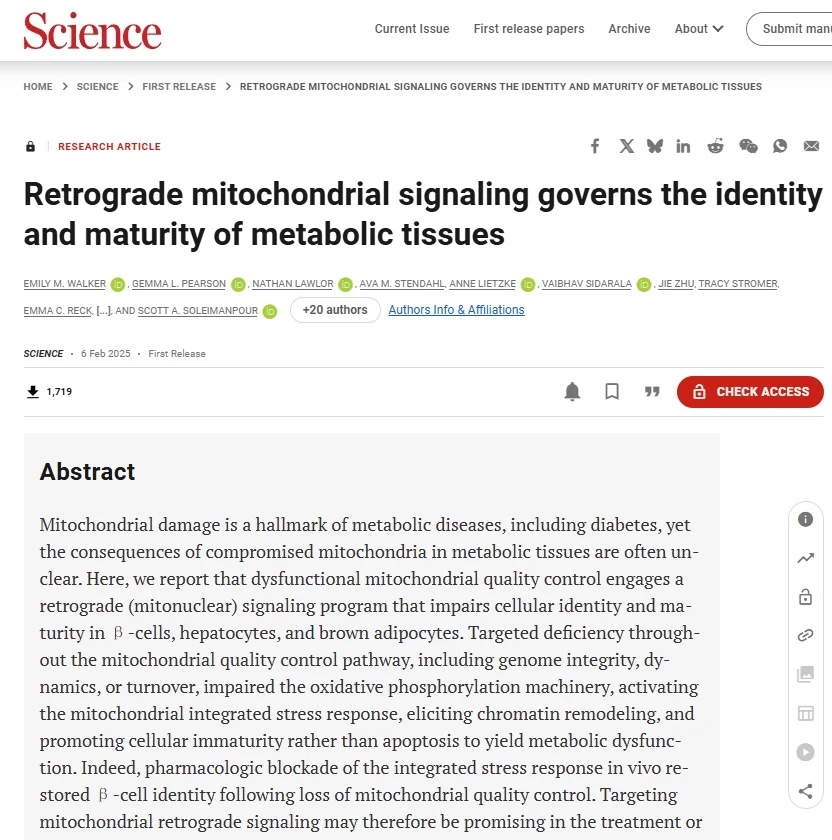
The research focuses on the “energy factories” of human cells - mitochondria. Imagine a city's power plant breaking down; the whole city would fall into chaos. In the insulin - producing cells (β - cells) of diabetes patients, the mitochondria have long been abnormal, but the causes and consequences have always remained a mystery.
The University of Michigan team designed a sophisticated experiment. By disrupting three key aspects of the mitochondria (DNA, the pathway for clearing damaged mitochondria, and the pathway for maintaining the number of healthy mitochondria), they unexpectedly found that disrupting any one of these links would trigger the same catastrophic domino effect. Damaged mitochondria first activate the cell's internal “alarm system” (stress response), which leads to changes in chromatin structure. Eventually, mature and fully functional β - cells “revert to youth” and turn back into an immature state.
“This ‘rejuvenation’ is by no means a good thing,” the lead researcher explained. “It's like an experienced insulin - producing technician suddenly losing their memory and becoming an unskilled apprentice.” As a result, β - cells “forget” how to produce insulin, leading to uncontrolled blood sugar. More importantly, the same mechanism has also been confirmed in liver cells and fat cells, which explains why diabetes causes systemic metabolic disorders, such as excessive sugar production in the liver, abnormal fat accumulation, and impaired muscle function.
However, the story doesn't end in despair. The research team found that these cells didn't die but were just “disabled.” They tried using a drug called ISRIB to block the cell stress - response pathway. A miracle happened after four weeks: in the treated mice, those “amnesic” β - cells “remembered” their mission and began to secrete insulin normally, effectively controlling blood sugar. This is like giving an amnesic technician an efficient “memory awakening” to restore their core skills.
“This opens up a brand - new treatment approach,” the corresponding author of the paper emphasized. “We no longer just focus on supplementing insulin but directly target the root cause, which is to repair the cells' own functional disorders.”
Currently, the research team is making every effort to explore ways to apply this breakthrough to human patients. They are conducting in - depth analyses of the damaged cell pathways in order to develop precise repair therapies.
Although it will take time to verify the transition from laboratory results to clinical applications, this discovery by the University of Michigan has undoubtedly lit the dawn of revolutionary treatment. It not only provides a new perspective for understanding diabetes but also gives hundreds of millions of patients around the world a glimmer of hope that one day, they can regain control of their blood sugar and enjoy a healthy future by awakening the dormant memory of their own cells.
Latest developments

The debut and discourse of the YinFeng Life Continuation Project not only served as an authoritative demonstration of its own ethical governance framework but also contributed practical wisdom toward establishing industry norms.

Yinfeng Foundation Honored as "2025 Public Welfare Donor" by Jinan Red Cross
Looking ahead, Yinfeng Foundation will use this recognition as an opportunity to further deepen its strategic collaboration with the Jinan Red Cross, expand cooperation in areas such as life health and emergency response, and continue to empower efforts to accelerate the construction of a "new, strong, excellent, rich, beautiful, and high-quality" modern socialist strong capital city, contributing even more Yinfeng strength to this endeavor.

The team successfully developed the CryoSIM platform, an intelligent microfluidics and deep learning-integrated system. This platform deeply integrates core technologies of deep learning and microfluidics to enable high-throughput, high-precision automated analysis of oocyte membrane permeability. It provides a novel technological tool for optimizing and advancing the clinical translation of oocyte cryopreservation techniques. Additionally, it offers an innovative practical paradigm for the application of artificial intelligence in low-temperature biomedicine and reproductive medicine.

Public Welfare Partnership: A Special Letter from the Jinan Red Cross
On the afternoon of January 30, 2026, the Jinan Red Cross presented a letter of special significance to the Shandong Yinfeng Life Science Public Welfare Foundation (hereinafter referred to as the Yinfeng Foundation).

World’s First Achievement Highlights Brand Leadership
In the future, Yinfeng Life Science Research Institute will continue to uphold its mission of "Dedicated to Medical Technology, Safeguarding Human Health." It will empower brand building with more original and pioneering scientific and technological achievements, contributing wisdom and strength to Shandong's goal of building a national regional innovation hub and promoting Chinese brands on the global stage.

Global First Ovarian Tissue Dual Activation Technology Debuts at 2025 Jinan Achievements Conference
Currently, the ovarian tissue dual activation technology has been successfully applied in clinical practice at Beijing University of Chinese Medicine Shenzhen (Longgang) Hospital, having treated over 400 patients with a treatment success rate of 70%. Over the next three years, Shandong Yinfeng Life Science Research Institute plans to use Jinan as a center to gradually expand the transformation and application of this technological achievement nationwide.
Yinfeng Life Continuation Plan
Address: Yinfeng Biotechnology Park, 1758 Gangyuan 6th Road, High-tech Zone, Jinan City, Shandong Province
Zip Code: 250102
Telephone: 0086-0531-88897351
Mobile: 0086-19953155515

Mobile website

Official WeChat Public Number
Links:Red Cross Society of China丨Shandong Red Cross Society丨Shandong Provincial Health Commission | Yinfeng Group| Yinfeng Biological Group
All rights reserved©Yinfeng Life Continuation Powered by www.300.cn SEO