

New breakthrough: Italian scientists pioneer a new paradigm for in - vivo gene therapy of hematopoietic stem cells.
Release time:
2025-07-21
In recent years, significant progress has been made in gene therapy for genetic diseases. In particular, the ex - vivo gene therapy strategy based on lentiviral vectors has been successfully applied to diseases such as severe combined immunodeficiency caused by adenosine deaminase deficiency (ADA - SCID). However, existing therapies still face challenges such as high toxic side effects of chemotherapy pre - treatment, complex operations, and high costs, and have limited efficacy for diseases involving multiple tissues.
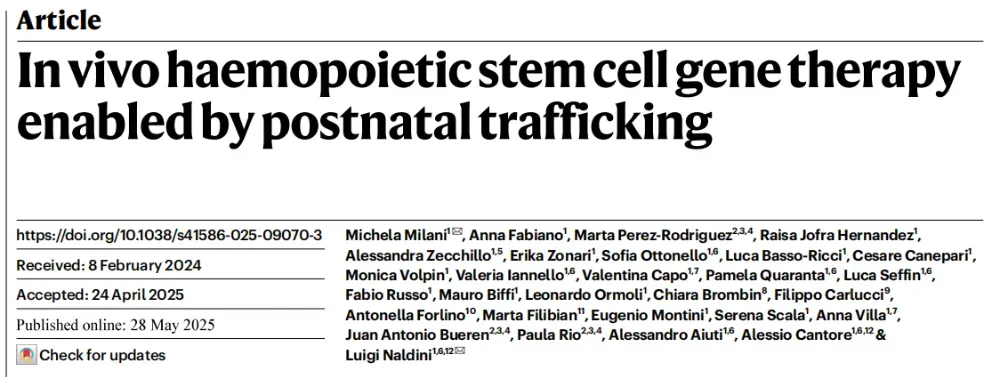
Recently, the teams led by Luigi Naldini and Michela Milani from the San Raffaele Scientific Institute in Italy published a groundbreaking study in Nature. They proposed an innovative in - vivo gene therapy strategy. By leveraging the biological characteristic of neonatal hematopoietic stem cells migrating from the liver to the bone marrow and combining it with an anti - phagocytic lentiviral vector (CD47high - LV), they successfully achieved efficient and low - toxicity gene modification, opening up a new path for the treatment of genetic blood diseases.
The research team first revealed the dynamic distribution pattern of neonatal hematopoietic stem cells: the number of hematopoietic stem cells in the peripheral blood of newborn mice is more than 10 times that of adult mice, and this numerical advantage persists within 2 weeks after birth. In addition, they precisely mapped the spatio - temporal dynamics of the migration of these cells from fetal hematopoietic organs to the bone marrow. Based on this, the team developed the CD47high lentiviral vector system. The high - expression CD47 molecule (a "don't eat me" signal) on its surface enables it to effectively evade the clearance of the immune system, and they designed multiple tissue - specific promoters to meet the needs of different diseases.
In three genetic disease models, this strategy showed significant efficacy:
In the ADA - SCID model: The survival rate of the treatment group reached 71%, significantly better than that of the control group, and the liver detoxification function synergistically enhanced the treatment effect.
In the Fanconi anemia model: Gene - corrected cells showed a selective advantage under the pressure of bone marrow failure, and the vector copy number increased from 0.1 to 1.0, almost completely reconstructing the hematopoietic system.
In the osteopetrosis model: Although the efficacy was limited, it confirmed the feasibility of the technology itself, and the rapid progression of the disease was the main limiting factor.
Notably, the number of hematopoietic stem cells in the peripheral blood of human neonates is also significantly higher than that of adults, providing direct evidence for clinical translation.
This study not only breaks through the bottleneck of ex - vivo gene therapy but also avoids the risks of chemotherapy pre - treatment and significantly reduces the treatment cost. This innovative paradigm provides a new solution for early - onset genetic diseases and marks a leap from "ex - vivo manipulation" to "in - vivo precise repair" in gene therapy. In the future, with the advancement of clinical translation, it is expected to bring hope of cure to more patients with genetic diseases.
Latest developments

The debut and discourse of the YinFeng Life Continuation Project not only served as an authoritative demonstration of its own ethical governance framework but also contributed practical wisdom toward establishing industry norms.

Yinfeng Foundation Honored as "2025 Public Welfare Donor" by Jinan Red Cross
Looking ahead, Yinfeng Foundation will use this recognition as an opportunity to further deepen its strategic collaboration with the Jinan Red Cross, expand cooperation in areas such as life health and emergency response, and continue to empower efforts to accelerate the construction of a "new, strong, excellent, rich, beautiful, and high-quality" modern socialist strong capital city, contributing even more Yinfeng strength to this endeavor.

The team successfully developed the CryoSIM platform, an intelligent microfluidics and deep learning-integrated system. This platform deeply integrates core technologies of deep learning and microfluidics to enable high-throughput, high-precision automated analysis of oocyte membrane permeability. It provides a novel technological tool for optimizing and advancing the clinical translation of oocyte cryopreservation techniques. Additionally, it offers an innovative practical paradigm for the application of artificial intelligence in low-temperature biomedicine and reproductive medicine.

Public Welfare Partnership: A Special Letter from the Jinan Red Cross
On the afternoon of January 30, 2026, the Jinan Red Cross presented a letter of special significance to the Shandong Yinfeng Life Science Public Welfare Foundation (hereinafter referred to as the Yinfeng Foundation).

World’s First Achievement Highlights Brand Leadership
In the future, Yinfeng Life Science Research Institute will continue to uphold its mission of "Dedicated to Medical Technology, Safeguarding Human Health." It will empower brand building with more original and pioneering scientific and technological achievements, contributing wisdom and strength to Shandong's goal of building a national regional innovation hub and promoting Chinese brands on the global stage.

Global First Ovarian Tissue Dual Activation Technology Debuts at 2025 Jinan Achievements Conference
Currently, the ovarian tissue dual activation technology has been successfully applied in clinical practice at Beijing University of Chinese Medicine Shenzhen (Longgang) Hospital, having treated over 400 patients with a treatment success rate of 70%. Over the next three years, Shandong Yinfeng Life Science Research Institute plans to use Jinan as a center to gradually expand the transformation and application of this technological achievement nationwide.
Yinfeng Life Continuation Plan
Address: Yinfeng Biotechnology Park, 1758 Gangyuan 6th Road, High-tech Zone, Jinan City, Shandong Province
Zip Code: 250102
Telephone: 0086-0531-88897351
Mobile: 0086-19953155515

Mobile website

Official WeChat Public Number
Links:Red Cross Society of China丨Shandong Red Cross Society丨Shandong Provincial Health Commission | Yinfeng Group| Yinfeng Biological Group
All rights reserved©Yinfeng Life Continuation Powered by www.300.cn SEO