

LUCAS, the first aid device that can fight death!
Release time:
2023-04-10
When someone suffers from respiratory arrest or cardiac arrest due to drowning, heart disease, high blood pressure, car accident, drug poisoning, gas poisoning, foreign matter blocking the respiratory tract, etc. we should provide emergency rescue in time to prevent the patient from not getting enough Timely rescue and resuscitation can cause irreversible damage to the brain and other important organs and tissues of the human body. The first aid method we use is called cardiopulmonary resuscitation (CPR), which is a life-saving technique for cardiac arrest and respiratory arrest. It uses chest compressions to restore the patient's spontaneous breathing and circulation.
In the cardiopulmonary resuscitation guidelines jointly developed by the International Resuscitation Federation and the American Heart Association, the content of cardiopulmonary resuscitation is formulated as: first performing chest compressions (Compressions), then opening the airway (Airway), and then artificial respiration (Breathing). ), get an automated external defibrillation (Defibrillation), or "C-A-B-D" as soon as possible.
Among them, chest compressions are divided into manual chest compressions and mechanical chest compressions. Manual chest compressions can provide initial and very important help when patients have cardiac arrest, but as time goes by, researchers found that 92.9% of compressions performed within the first minute were effective, and 92.9% of the compressions performed within the second minute were effective. It begins to gradually decrease at the 5th minute, and at this time the rescuers will hardly be aware of this decrease; in addition, the rescuer's compression rate is less than 90 times per minute for 1/3 of the duration of cardiac arrest, and 40% The time of pressing is too shallow. In addition to the above problems, there are also problems such as the inability to provide sufficient cardiac output and the inability to receive defibrillation treatment at the same time.
Because high-quality manual chest compressions can be challenging or dangerous for rescuers, mechanical chest compressions are generally considered in specific situations, as long as interruptions in CPR are strictly limited during deployment and removal of the device. Press the device.
Currently, commonly used mechanical chest compression devices include LUCAS and AutoPulse. Among them, LUCAS helps rescuers by providing effective, consistent and continuous chest compression methods recommended in the American Heart Association guidelines. This is a portable tool designed to eliminate the problems associated with manual chest compressions. LUCAS is the abbreviation of "Lund University Cardiac Assist System", and the official trademark is LUCAS. LUCAS is commonly used to perform chest compressions on adult patients who experience acute cardiac arrest (i.e., loss of spontaneous breathing, pulse beat, and unconsciousness).
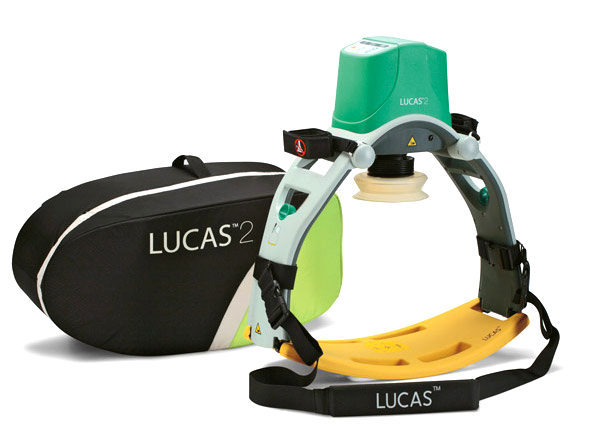
LUCAS not only improves the quality of chest compressions, but also reduces the interruption time when transitioning from manual to LUCAS mechanical chest compressions; it also provides high quality during patient movement, transportation, prolonged CPR, and in the cath lab. , stable chest compressions. Paramedic safety is also protected, whether that's the risk to paramedic safety in an ambulance crash or the risk of exposure to X-rays during PCI in the cath lab.
Clinical trials have proven that LUCAS is not only safe and effective, causing damage comparable to manual chest compressions, but also has very good neurological results. It can also significantly increase the ROSC rate from 26% to 41%, providing the human body with more than 15mmHg threshold. Coronary perfusion pressure and coronary blood flow (TIM III), increase the average ETCO2 value. Compared with manual chest compressions, the chest compression score recorded by LUCAS is as high as 93%, the ventilation time is longer, and stable depth and rate can be maintained. In addition, the LUCAS device can defibrillate outside the suction cup during continued compressions without stopping. Therefore, the highest quality chest compressions provided by LUCAS avoid the hazards of low-quality chest compressions and become an alternative to manual chest compressions. However, LUCAS is not limited to cardiopulmonary resuscitation, it also plays an important role in the field of cryopreservation.
In the human cryopreservation project conducted by Yinfeng Cryo-Cryogenics and Shandong Yinfeng Life Sciences Research Institute, LUCAS 2 was used to maintain the physiological functions of volunteers. LUCAS 2 is the second generation product of LUCAS. Unlike the compressed air drive of the first generation device, LUCAS 2 is powered by batteries. During the implementation of the human cryopreservation project, LUCAS 2 performed chest compressions to restore the heart pumping blood of volunteers immediately after clinical death, transport nutrients and oxygen to the whole body, and slow down the degeneration of cells, tissues and organs throughout the body. exhaustion and apoptosis to maintain the body functions of volunteers; because LUCAS 2 is powered by batteries, it can be continuously used during transfer and surgery without interfering with other operations; during the transfer process, LUCAS 2 provides power to the blood It helps the rapid diffusion of low-temperature saline, helps the body quickly cool down, and reduces the respiration of body cells; in addition, it provides signals for arterial and venous intubation in the early stages of surgery, speeding up initial preparations for surgery.
The series of professional medical devices such as LUCAS 2 used by Shandong Yinfeng Life Sciences Research Institute are not only an expansion of the application direction of professional medical devices, but also a reflection of a serious and responsible attitude towards the great cause of human body cryopreservation. Using professional medical The equipment serves volunteers and creates an environment conducive to the development of human cryopreservation, making human preservation closer to clinical practice and allowing more advanced medical technologies to enter human preservation.
Further reading:
A brief history of LUCAS
In the 1990s, Norwegian paramedic Willy Vistung saw a resuscitation attempt on a patient being transported on a stretcher and wondered how cardiopulmonary resuscitation (CPR) could be improved. He found Professor Stig Steen from Lund University Hospital in Sweden, hoping to overcome the limitations of manual CPR by manufacturing an automatic chest compressor. In the late 1990s, development of the LUCAS device began. Professor Stig Steen and his team conducted a series of experimental studies to better understand the pathophysiology of cardiac arrest and the efficacy of chest compressions. The study attracted global attention and showed that effective chest compressions are critical to outcomes. In experimental pig studies, LUCAS was shown to significantly improve coronary perfusion pressure and cerebral blood flow compared with manual compressions.
In 2003, the first pneumatic LUCAS1 device was clinically used in an ambulance in Sweden. LUCAS was immediately appreciated because it frees up hands, reduces clutter around the patient, and increases safety when providing CPR in a moving ambulance. In 2009, the second-generation battery-powered LUCAS2 was launched globally.
A growing number of emergency medical systems and hospitals in the United States, Europe and Asia are using the device. In June 2016, the third generation of LUCAS was launched as LUCAS3.
Latest developments

The debut and discourse of the YinFeng Life Continuation Project not only served as an authoritative demonstration of its own ethical governance framework but also contributed practical wisdom toward establishing industry norms.

Yinfeng Foundation Honored as "2025 Public Welfare Donor" by Jinan Red Cross
Looking ahead, Yinfeng Foundation will use this recognition as an opportunity to further deepen its strategic collaboration with the Jinan Red Cross, expand cooperation in areas such as life health and emergency response, and continue to empower efforts to accelerate the construction of a "new, strong, excellent, rich, beautiful, and high-quality" modern socialist strong capital city, contributing even more Yinfeng strength to this endeavor.

The team successfully developed the CryoSIM platform, an intelligent microfluidics and deep learning-integrated system. This platform deeply integrates core technologies of deep learning and microfluidics to enable high-throughput, high-precision automated analysis of oocyte membrane permeability. It provides a novel technological tool for optimizing and advancing the clinical translation of oocyte cryopreservation techniques. Additionally, it offers an innovative practical paradigm for the application of artificial intelligence in low-temperature biomedicine and reproductive medicine.

Public Welfare Partnership: A Special Letter from the Jinan Red Cross
On the afternoon of January 30, 2026, the Jinan Red Cross presented a letter of special significance to the Shandong Yinfeng Life Science Public Welfare Foundation (hereinafter referred to as the Yinfeng Foundation).

World’s First Achievement Highlights Brand Leadership
In the future, Yinfeng Life Science Research Institute will continue to uphold its mission of "Dedicated to Medical Technology, Safeguarding Human Health." It will empower brand building with more original and pioneering scientific and technological achievements, contributing wisdom and strength to Shandong's goal of building a national regional innovation hub and promoting Chinese brands on the global stage.

Global First Ovarian Tissue Dual Activation Technology Debuts at 2025 Jinan Achievements Conference
Currently, the ovarian tissue dual activation technology has been successfully applied in clinical practice at Beijing University of Chinese Medicine Shenzhen (Longgang) Hospital, having treated over 400 patients with a treatment success rate of 70%. Over the next three years, Shandong Yinfeng Life Science Research Institute plans to use Jinan as a center to gradually expand the transformation and application of this technological achievement nationwide.
Yinfeng Life Continuation Plan
Address: Yinfeng Biotechnology Park, 1758 Gangyuan 6th Road, High-tech Zone, Jinan City, Shandong Province
Zip Code: 250102
Telephone: 0086-0531-88897351
Mobile: 0086-19953155515

Mobile website

Official WeChat Public Number
Links:Red Cross Society of China丨Shandong Red Cross Society丨Shandong Provincial Health Commission | Yinfeng Group| Yinfeng Biological Group
All rights reserved©Yinfeng Life Continuation Powered by www.300.cn SEO