

breakthrough! 3D nano-ink breaks the bottleneck
Release time:
2021-11-24
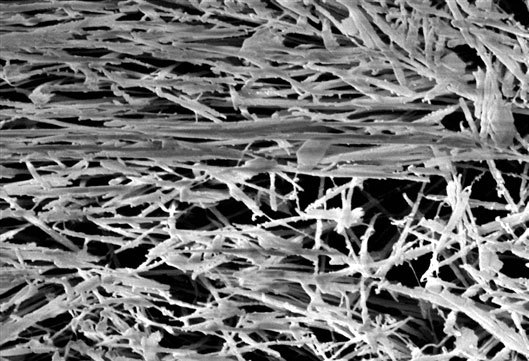
After plasma etching the polymer, electron microscopy shows the alignment of the nanomaterials in the 3D printing direction.
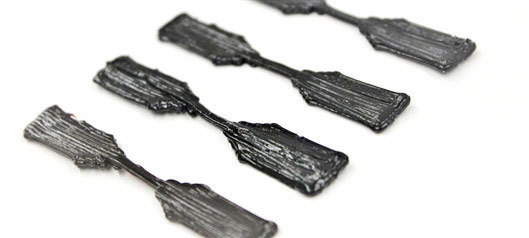
3D printed “dog bone-shaped” nanocomposite tensile test sample.
A new 3D printable polymer nanocomposite ink has incredible properties and finds widespread use in aerospace, medicine and electronics.
Mechanical engineering researchers at Michigan Technological University in the United States have invented a method to use carbon nanotubes (CNTs) to make 3D printing nanocomposite polymer ink, which is expected to replace traditional epoxy resin.
Engineer Parisa Pour Shahid Saeed Abadi and graduate student Masoud Kasrae, who study the interface of materials, mechanics and medicine, recently published an article in the journal Additive Manufacturing and noted that this material has great promise beyond the scientific scope of nanocomposite ink.
The conductivity of the new nanomaterial ink makes it possible to print epoxies that double as wires — whether on circuit boards, aircraft wings, or in 3D printed drivers used to guide vascular catheters. Another useful property of nanocomposite polymer ink is its strength. "Compared to steel and aluminum, we found that epoxy composites with the same strength can reduce weight by 80%," Kasrae said.
Additionally, in the medical, aerospace and electronics industries, where defects and damage can cause serious trouble, nanocomposites can serve safety functions. "When something breaks, a tiny crack starts from a tiny defect and grows to destroy the entire structure," Abadi said. "Nanocomposites can bridge those cracks without allowing them to grow. This is one of the mechanisms by which carbon nanotubes increase the mechanical strength of materials."
In the future, polymer nanocomposite inks are expected to replace traditional epoxy resins. Performance, weight ratio, conductivity, increased strength and ease of use are just a few of the reasons, the authors say.
Latest developments

The debut and discourse of the YinFeng Life Continuation Project not only served as an authoritative demonstration of its own ethical governance framework but also contributed practical wisdom toward establishing industry norms.

Yinfeng Foundation Honored as "2025 Public Welfare Donor" by Jinan Red Cross
Looking ahead, Yinfeng Foundation will use this recognition as an opportunity to further deepen its strategic collaboration with the Jinan Red Cross, expand cooperation in areas such as life health and emergency response, and continue to empower efforts to accelerate the construction of a "new, strong, excellent, rich, beautiful, and high-quality" modern socialist strong capital city, contributing even more Yinfeng strength to this endeavor.

The team successfully developed the CryoSIM platform, an intelligent microfluidics and deep learning-integrated system. This platform deeply integrates core technologies of deep learning and microfluidics to enable high-throughput, high-precision automated analysis of oocyte membrane permeability. It provides a novel technological tool for optimizing and advancing the clinical translation of oocyte cryopreservation techniques. Additionally, it offers an innovative practical paradigm for the application of artificial intelligence in low-temperature biomedicine and reproductive medicine.

Public Welfare Partnership: A Special Letter from the Jinan Red Cross
On the afternoon of January 30, 2026, the Jinan Red Cross presented a letter of special significance to the Shandong Yinfeng Life Science Public Welfare Foundation (hereinafter referred to as the Yinfeng Foundation).

World’s First Achievement Highlights Brand Leadership
In the future, Yinfeng Life Science Research Institute will continue to uphold its mission of "Dedicated to Medical Technology, Safeguarding Human Health." It will empower brand building with more original and pioneering scientific and technological achievements, contributing wisdom and strength to Shandong's goal of building a national regional innovation hub and promoting Chinese brands on the global stage.

Global First Ovarian Tissue Dual Activation Technology Debuts at 2025 Jinan Achievements Conference
Currently, the ovarian tissue dual activation technology has been successfully applied in clinical practice at Beijing University of Chinese Medicine Shenzhen (Longgang) Hospital, having treated over 400 patients with a treatment success rate of 70%. Over the next three years, Shandong Yinfeng Life Science Research Institute plans to use Jinan as a center to gradually expand the transformation and application of this technological achievement nationwide.
Yinfeng Life Continuation Plan
Address: Yinfeng Biotechnology Park, 1758 Gangyuan 6th Road, High-tech Zone, Jinan City, Shandong Province
Zip Code: 250102
Telephone: 0086-0531-88897351
Mobile: 0086-19953155515

Mobile website

Official WeChat Public Number
Links:Red Cross Society of China丨Shandong Red Cross Society丨Shandong Provincial Health Commission | Yinfeng Group| Yinfeng Biological Group
All rights reserved©Yinfeng Life Continuation Powered by www.300.cn SEO